ONLINE TRAINING FOR SMALL TEAMS
Online Staff Training for Small Businesses
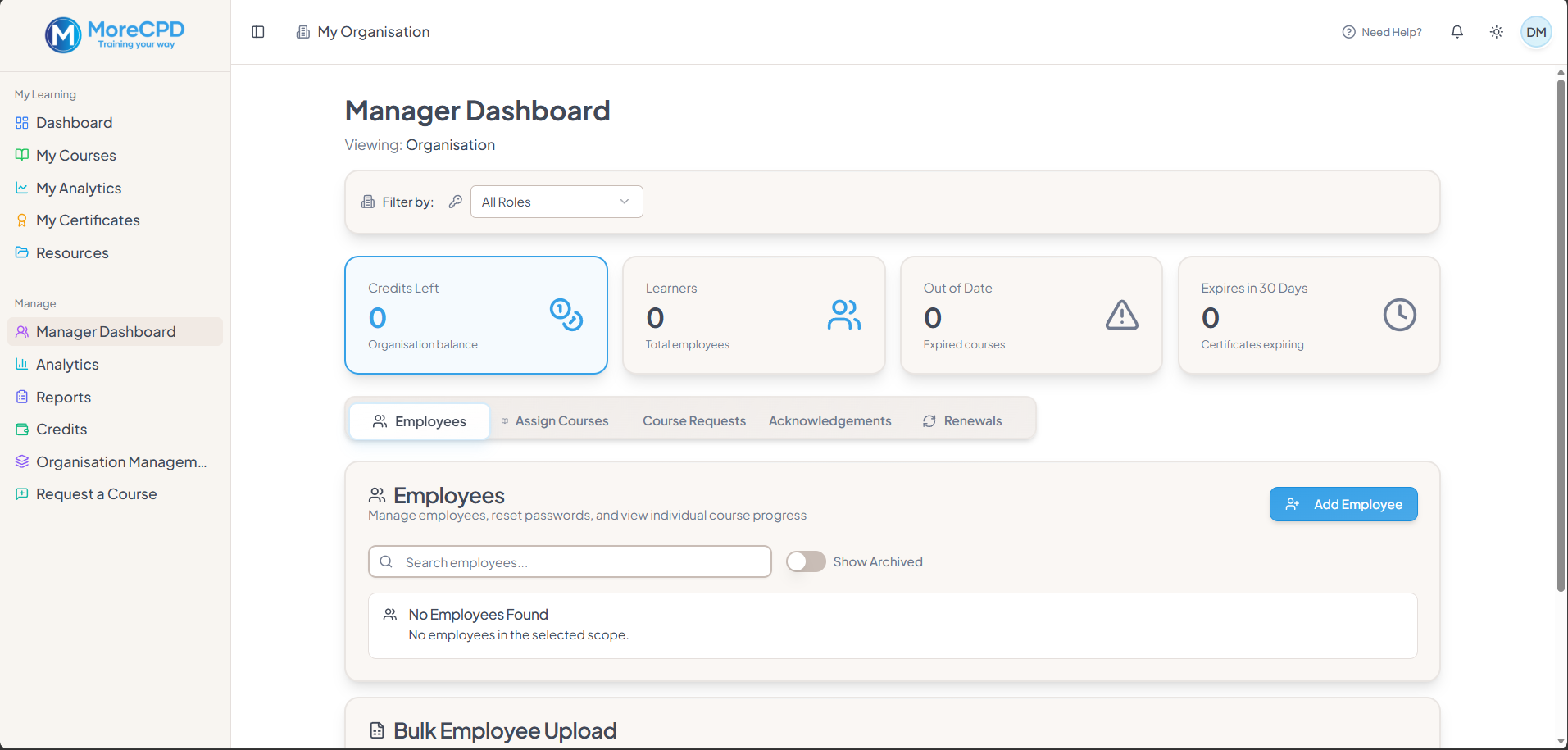
Train your team without buying courses one by one or chasing certificates in spreadsheets. MoreCPD gives small businesses access to the entire e-learning library, with an easy-to-use LMS for assigning and tracking learning from Starter plans upwards.
Train one person from £18 + VAT a month, or a team of up to 10 from £45 + VAT a month. All subscriptions have a 12-month commitment.
View small business plans Explore training topics
Start with the training your roles need
Examples below are selected only from eligible courses in the current public catalogue.
Health and safety
Awareness learning for workplace risks and safer working practices.
- Health and Safety for Managers Level 3 — 6 hours
This Health and Safety for Managers (Level 3) course is ideal for management, executives and supervisors looking to get an in-depth understanding of health and safety and what they can do to keep their employees safe at work whilst fulfilling their legal responsibilities.
Many learners find the prospect of learning about health and safety quite daunting. As such, this course breaks down the content into smaller manageable chunks and provides plenty of opportunities to test your knowledge. Interactive tasks, videos and written guidance are used to provide the knowledge and skills to understand workplace hazards and apply appropriate control measures to reduce the risk.
This health and safety course will look at carrying out risk assessments, identifying common workplace hazards, looking at suitable controls to reduce the risk and understanding your responsibilities towards health and safety.
- Health and Safety at Work Level 2 — 2 hours
This Health and Safety at work (Level 2) course is ideal for anyone looking to gain a better understanding of health and safety and what they can do in the workplace to ensure they remain safe. Using interactive tasks, videos and written guidance, this online course covers many health and safety topics to develop an understanding of safe practices within the workplace.
This course looks at carrying out risk assessments as well as identifying common workplace hazards such as manual handling, electricity, hazardous substances, fire, and working at height. Many learners find the prospect of learning about health and safety quite daunting. As such, this course breaks down the content into smaller manageable chunks and provides plenty of opportunities to test your knowledge.
Manual handling
Learning for teams whose work involves lifting, carrying or moving loads.
- Manual Handling Training — 2 hours
Manual handling related injuries are amongst some of the most common ways in which people hurt themselves in the workplace. Therefore, its vital that everyone is made aware of these risks and how they can go about reducing them.
This Manual Handling Awareness course is designed to ensure staff are trained in safe manual handling practices. It follows the requirements of the Manual Handling Operations Regulations (MHOR) to provide practical guidance on carrying out safe manual handling.
Data protection and cyber security
Practical awareness for handling information and reducing everyday security risk.
- Data Protection & GDPR Training — 1 hours
If you frequently work with data, it is essential that you remain up to date with your data protection knowledge. This online data protection & GDPR awareness course will give you an introduction into how to safely handle data within UK GDPR guidelines and how you can keep your business and your clients safe.
This online data protection training course starts off by introducing you to data protection and GDPR. It then moves on to cover why data protection is important and the key terminology you will need to know followed by some real life cases studies. The course also explores the 7 data protection principles, data subjects’ rights, and the purpose of consent. Lastly, it covers topics such as different security measures, what you should do in the event of a data breach, and how the ICO plays a role in this.
Safeguarding
Relevant awareness learning for organisations working with children or vulnerable people.
- Safeguarding Adults Level 2 — 3 hours
This online Safeguarding Adults course covers the different types of abuse and how to spot their signs and symptoms. It also explains what you should do if you see or hear a safeguarding issue, how to document it and how it can be reported. The course also provides sources of support as well as other resources which can be used to help you. A mixture of videos, interactive tasks, written content and tests are used to maximise the learning experience.
- Safeguarding Children Awareness — 2 hours
This online safeguarding course covers the different types of child abuse and how to spot their signs and symptoms as well as protective and risk factors for children. The course also explains what you should do if you see or hear a safeguarding issue, how to document it and how it can be reported. The course also provides other resources and sources of support for you and the child. A mixture of videos, interactive tasks, written content and tests are used to maximise the learning experience.
- Safeguarding Children Level 2 — 2 hours
If you work with under 18s, you have a responsibility to safeguard them. This Safeguarding Children Level 2 looks at what this responsibility involves and how you could help keep them safe.
This Advanced Safeguarding Children course covers the many different types of child abuse. In particular it focuses on their signs and symptoms and what you can do if you have any concerns. The course explains what you should do if you see or hear a safeguarding issue, how to document it and how it can be reported. This online safeguarding course also looks at protective and risk factors for children as well as providing sources of support for you and the child.
People, equality and wellbeing
Support respectful workplaces, wellbeing conversations and people management.
- Mental Health at Work for Managers — 4 hours
This mental health at work for managers course is specifically designed to educate management about what they can do within the workplace to support their employees’ (and their own) mental health. This course covers what mental health is, the relevant legislation, common mental health conditions, the signs of poor mental health and how to talk about mental health with colleagues. This course also looks at what can be done at an organisational level to aid their employee’s mental health.
This mental health course covers the common types of mental health conditions including: Anxiety, Depression, Stress, Post Traumatic Stress Disorder (PTSD), Panic disorder, Phobias, Obsessive Compulsive Disorder (OCD), Eating disorders, Bipolar Disorder, Schizophrenia and Psychosis.
- Mental Health Awareness at Work — 3 hours
This mental health awareness at work course is specifically designed for anyone looking to increase their knowledge around mental health in the workplace. This course covers the signs of poor mental health generally, as well as in the workplace. It also looks at the relevant legislation, common mental health conditions, how to support your colleagues in the workplace as well as how to support your own mental health.
This mental health course covers several common types of mental health conditions including Anxiety, Depression, Stress, Post Traumatic Stress Disorder (PTSD), Panic Disorder, Phobias, Obsessive Compulsive Disorder (OCD), Eating disorders, Bipolar Disorder, Schizophrenia and Psychosis.
- Mental Health Awareness — 2 hours
With around 1 in 4 people experiencing mental health issues each year, it is highly important that everyone has an understanding of what mental health is, the signs and symptoms of poor mental health and how they can help both themselves and someone else with a mental health difficulty.
This Mental Health Awareness course is perfect for anyone looking to increase their knowledge of mental health. The course looks at what mental health is, factors effecting mental health, common mental health conditions, spotting the signs and symptoms of mental ill health and looking at what you can do to support yourself and others with mental health related issues.
Small business staff training questions
What staff training does a small business need?
There is no single course list for every UK small business. Employers should assess the roles, workplace risks and legal duties that apply to their organisation, then add the site-specific instruction, supervision and practical training those duties require. MoreCPD helps organise online learning and records; it does not determine your legal duties.
Is employee training legally required for a small business?
Some employee training may be legally required, depending on the work, risks and duties involved. Check the legislation and official guidance that applies to your business, and obtain competent advice where necessary rather than relying on a universal course list.
How do I decide which courses each employee needs?
Start with each employee’s role, responsibilities, workplace risks and experience. Use current risk assessments, official sector guidance and your own policies to separate shared awareness learning from role-specific, practical or regulated training.
Does every employee need the same training?
No. Employees in the same business can need different learning because their tasks, risks and levels of responsibility differ, although some induction or awareness topics may be useful across the team.
Can employees complete their training online?
Online courses can support awareness, induction and knowledge-based learning. Your business should supplement online learning with its own policies, site information, practical instruction and assessment where the topic or role requires them.
Can I assign different courses to different staff members?
Yes. Starter and larger team plans include the manager LMS, allowing managers to add staff, assign courses and review progress rather than giving every employee an identical programme.
Can MoreCPD help with new-starter training?
Yes. Managers on Starter and larger plans can assign relevant MoreCPD courses to new learners and monitor completion. Your own workplace induction, policies, emergency procedures, supervision and practical instruction should still be provided where needed.
Can I track certificates and renewal dates?
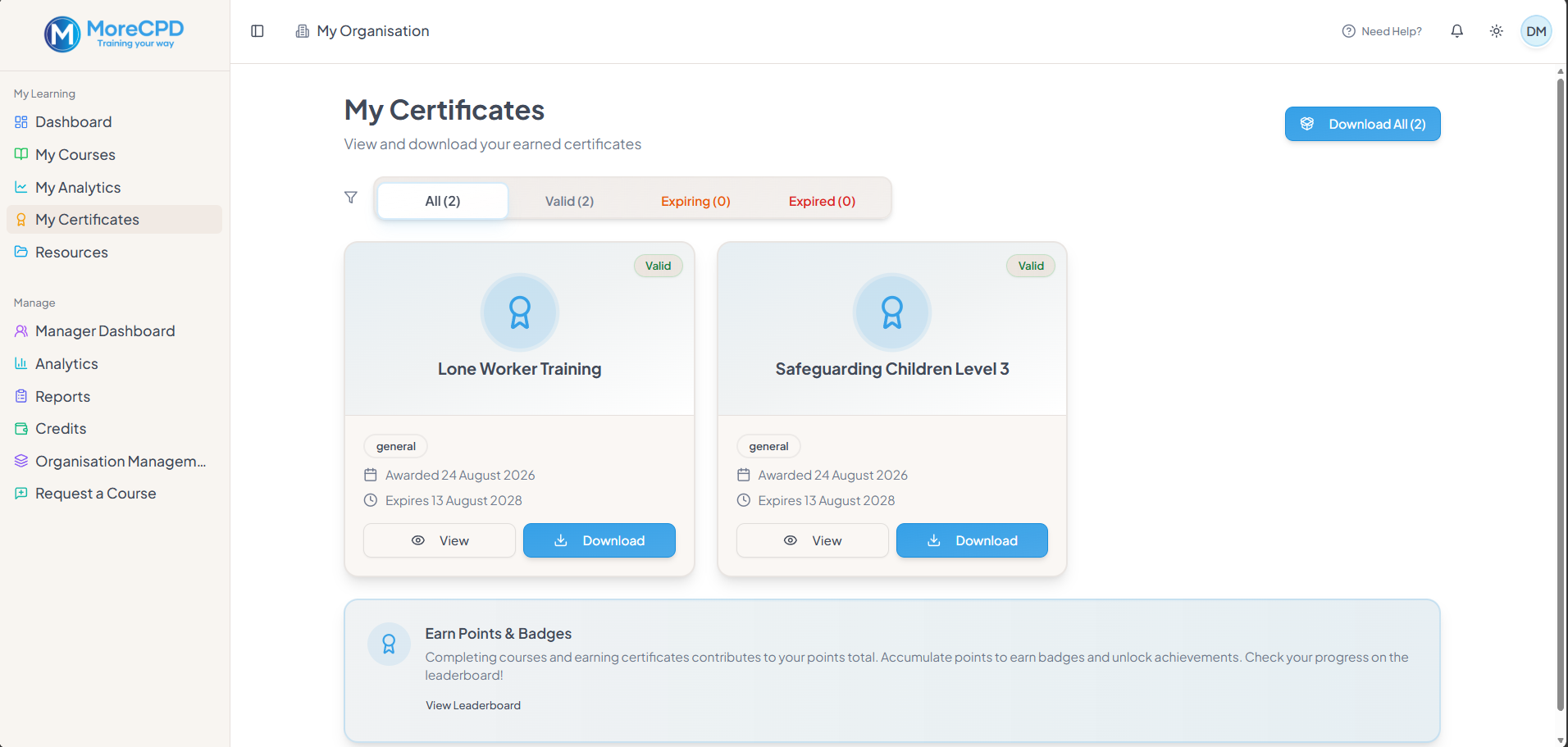
Yes. Team plans provide manager access to MoreCPD completion records, certificates and renewal information, helping you keep those training records together and identify learning that may need review.
Is the LMS included?
The manager LMS is included from the Starter plan upwards. Solo provides one learner with access to the e-learning library but does not include the team-management LMS.
Is there a plan for just one employee?
Yes. Solo provides one learner with access to the entire e-learning library for £18 + VAT a month or £180 + VAT annually, with a 12-month commitment.
What happens if the business grows beyond 10 or 30 learners?
Growth covers 11–30 learners, Business covers 31–75, and Enterprise is available for 76 or more. Speak to MoreCPD if your learner numbers are likely to change during the subscription.
Does online learning replace practical workplace training?
No. Online learning can support consistent knowledge and awareness, but it does not automatically demonstrate competence or replace workplace induction, supervision, practical instruction, competency checks or regulated qualifications where these are required.
How much does online staff training cost for a small business?
Solo is £18 + VAT monthly for one learner. Starter is £45 + VAT monthly for up to 10 learners; Growth is £95 for 11–30; Business is £195 for 31–75; and Enterprise for 76+ learners is bespoke. Every subscription has a 12-month commitment. Annual pricing equals ten monthly payments.
Can IOSH or Mental Health First Aid training be added?
Yes. IOSH and Mental Health First Aid can be added as separate purchases alongside the standard Staff Training Subscription; they are not included in the subscription library. Subscriber discounts may apply, so contact MoreCPD to discuss the available options.